
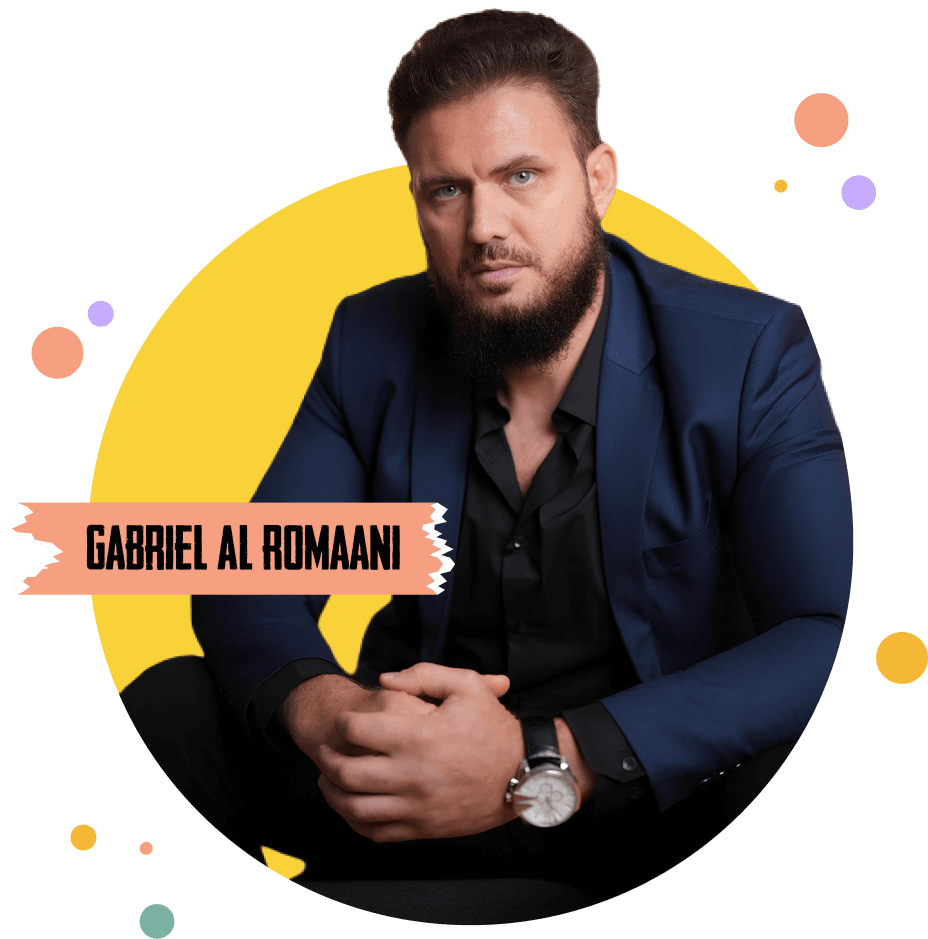
Gabriel Al Romaani is a Positive Islamic Psychology Coach, Educational Consultant, and Media Presenter with over two decades of experience in Islamic guidance, spiritual mentorship, daʿwah, education, and institutional leadership.
His journey into Islam began in 2003 after years of dedicated study. From the outset, he became actively involved in community guidance and mentorship in Canada, beginning with the Windsor Islamic Association, where he served in a community support and Islamic guidance capacity, including as a New Muslim Coordinator. In this role, he worked closely with new Muslims and their families, supporting them through their transition to Islam and helping them navigate personal, familial, and social challenges within a faith-based framework.
Alongside this work, he served with the Muslim Student Association of Windsor as a primary point of support for both local and international students. Through sustained engagement, he assisted students in navigating crises of faith, family pressures, emotional distress, relationship challenges, cultural displacement, and identity struggles throughout their university years. Much of this work involved supporting international students adjusting to life in Western environments, many facing isolation, culture shock, exposure to harmful influences, and separation from family support systems. Through Islamic guidance, mentorship, and daʿwah, he helped many students restore emotional stability, reconnect with their faith, and return to Islam after periods of doubt or disengagement—by Allah’s permission.
A graduate of Mishkah University (USA), Br Gabriel holds an Associate's Degree and a Bachelor's in Islamic Studies. His educational background includes a double major in Biology and Psychology Neuroscience and Cognition, along with graduation from the Faculty of Education at the University of Windsor, Canada. During his studies, he conducted research on Parkinson's disease, and his thesis examined the Morris water maze, a widely used behavioral test for studying spatial learning and memory. This background in neuroscience informs his evidence-based approach to well-being and personal development.
Since 2004, Gabriel has also served as a khateeb, delivering Friday khutbahs and public lectures at universities and masājid internationally. He served as an official khateeb in Dubai, delivering khutbahs at Masjid Maryam and Masjid Bil Yuha, as well as in Fujairah. He has also contributed as a media presenter and guest speaker on platforms such as Peace TV, Huda TV, and Iqraa TV.
From 2009, Gabriel served in Islamic education as a teacher, school principal, and General Director. He also served as an Educational Consultant to Islamic schools and organizations. Throughout this period, he devoted extensive hours to one-on-one mentorship and faith-based guidance for students, teachers, and families, while also advising institutions on leadership development, student support and spiritual guidance frameworks, curriculum alignment, policy formation, and sustainable institutional growth.
Complementing his established career in Islamic education and mentorship, Br Gabriel completed a certificate in Existential Well-being Counselling from KU Leuven, Belgium, reflecting his commitment to holistic well-being. Further, he holds a certification specializing in Children and Family Achievers from the Positive Islamic Psychology Center and Khalifa Education Foundation, Malaysia.
From the time he entered Islam, Gabriel remained actively engaged in mentoring and Islamic guidance. In 2021, he formally established Positive Islamic Psychology (PIP Coaches) to structure and offer this long-standing faith-based guidance and coaching work, developed through nearly two decades of sustained observation, direct experience, and practical application rather than reaction to popular or influencer-driven trends.
Muslim Alpha began in 2019 as a men’s personal development initiative rooted in the Qur’an and Sunnah. The program was intentionally developed in response to consistent, real-world needs observed in men’s character formation, leadership development, and marriage preparation, with its master courses reflecting lived experience rather than transient trends.
Alongside his professional work, Gabriel pursued the Islamic sciences through traditional, structured study under qualified scholars, following established methods of scholarly transmission. He studied under two Azharī scholars, each in distinct disciplines, and received permission for Da'wah and to convey what was taken. His studies included Sīrah, ʿAqīdah, Fiqh, Uṣūl al-Daʿwah, Tarbiyah, Qur’an, Uṣūl al-Fiqh, and Muṣṭalaḥ al-Ḥadīth.
He also studied under scholars from Saudi Arabia who were students of the students of Shaykh Ibn ʿUthaymīn, Shaykh al-Albānī, and Shaykh Abū Bakr al-Jazāʾirī, benefiting from their transmitted methodology in creed, jurisprudence, ḥadīth, and daʿwah.
In addition to this, he holds ijāzāt in selected classical works, including the Forty Ḥadīth of Imām al-Nawawī, Kitāb al-Fitnah from Ṣaḥīḥ al-Bukhārī, Kitāb al-Tibyān, and al-Adhān.
With over 20 years of experience in the educational field, Gabriel has played a significant role in working with students, families, and counseling. His extensive expertise adds depth to his coaching and consulting roles, promoting positive psychology principles rooted in Islamic teachings.



